
What Is Your Team’s Patch?
How Strong Teams Build Identity Without Losing Alignment
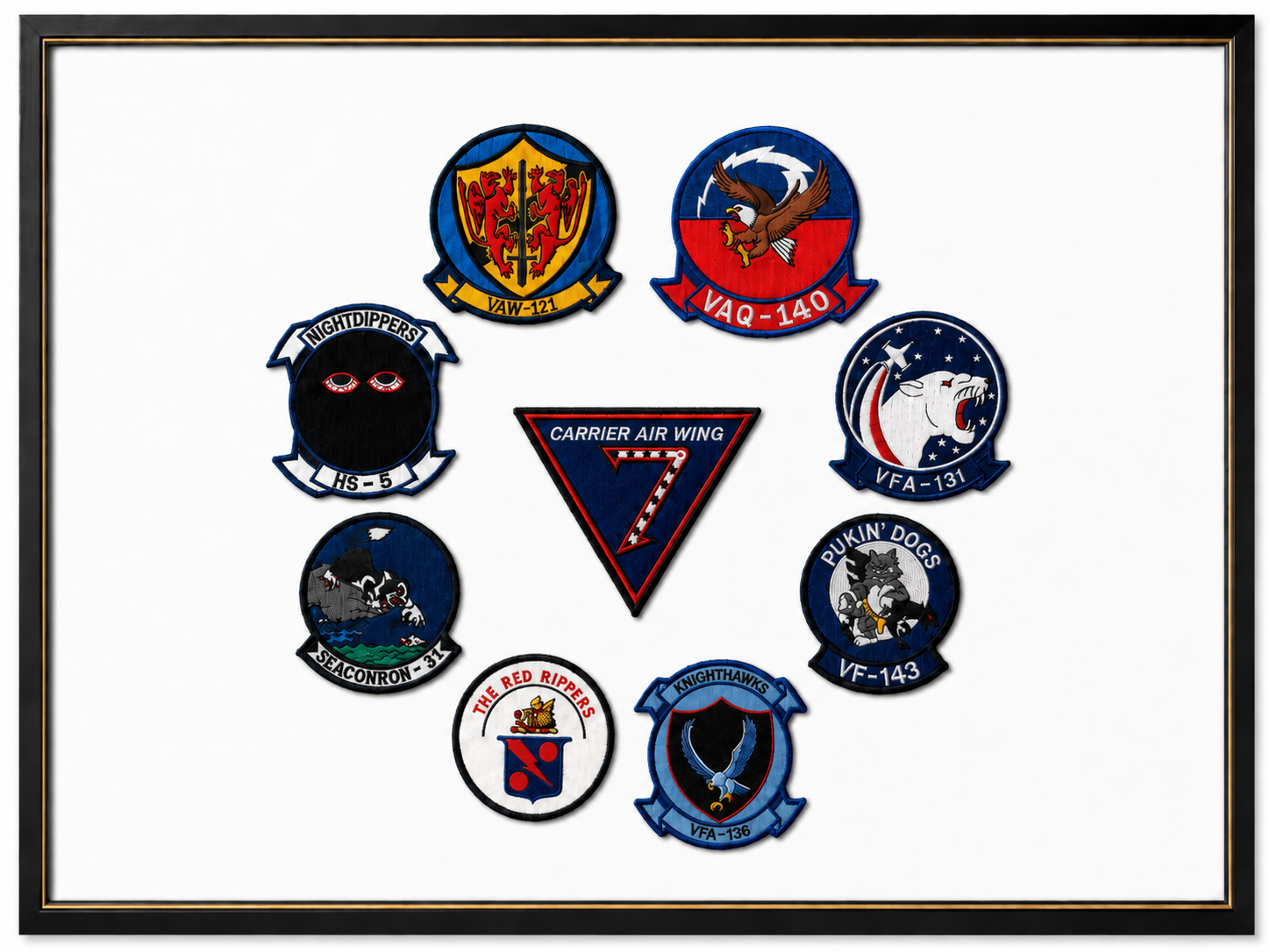
When I commanded Carrier Air Wing Seven, eight squadrons came together on the USS Eisenhower and USS Kennedy to operate as one air wing. They did not all have the same mission. Two F-14 squadrons flew fighter missions. Two F/A-18 squadrons performed strike-fighter missions. Other squadrons provided electronic warfare, airborne early warning, antisubmarine warfare, and helicopter support.
Each squadron had a distinct role, but all contributed to the air wing’s larger mission. We followed the same standards, operational procedures, and military norms. We launched from the same carrier, flew in the same airspace, and depended on one another to execute safely and effectively.
But each squadron also had its own identity.
Each had its own patch, traditions, personality, history, and reputation. Sailors and aircrew were proud to be members of the Navy and proud to belong to the air wing. But their most immediate sense of connection was to their squadron. That was where relationships were built. That was where standards were lived. That was where pride, camaraderie, and accountability became personal.
The patches surrounding the Carrier Air Wing Seven emblem tell the story visually: one larger organization made stronger by teams with distinct identities.
ALIGNMENT DOES NOT REQUIRE SAMENESS
Organizations often worry that strong team identities will create silos. That can happen. A team can become so inwardly focused that loyalty to the group begins to compete with loyalty to the larger mission. But the answer is not to eliminate team identity. The answer is to align it.
The organization should be clear about the larger mission, values, standards, and operating expectations that apply to everyone. Within that framework, teams should have room to develop their own identity, customs, traditions, and sense of pride.
Too little alignment creates fragmentation.
Too little team identity creates compliance without belonging.
Strong organizations build both.
WHY IDENTITY MATTERS
People want to belong to something they are proud of. A strong team identity tells members: This is who we are. This is what we stand for. This is how we work. This is what others can expect from us.
That identity creates ownership. Members stop thinking of the work as something assigned by the organization and begin to see their team’s reputation as something they personally help build and protect.
It creates pride. People want to perform well because their performance reflects on the team and their teammates.
It creates camaraderie. Shared symbols, stories, traditions, and experiences strengthen the relationships that help people face challenges, make sacrifices, and recover from setbacks.
And it creates accountability. When the team has a clear identity, members are more likely to challenge behavior that does not fit the standards they represent.
A strong team identity can outlast the people who created it. In a Navy squadron, members typically serve a three-year tour. They do not all rotate at once, but over a relatively short period everyone has changed. Yet the squadron’s stories, standards, reputation, and culture endure.
That does not happen by accident. It is reinforced by leadership at every level: the commanding officer and executive officer, and also officers, chief petty officers, and petty officers throughout the chain of command. Each generation teaches the next what it means to belong to that team.
REPUTATIONS ENDURE
Not all squadrons are equal. Some consistently perform better than others. Some develop enduring reputations for excellence that last many years despite the constant turnover of people.
Companies are the same. The people change, but, for good or ill, the story remains: This is who we are. This is what we stand for. This is what it means to be a member of this team.
That story shapes expectations. New members arrive and quickly learn what the team values, what standards it protects, and what behavior earns respect. When leaders at every level reinforce the story through their decisions and actions, identity becomes culture.
FRIENDLY COMPETITION CAN RAISE THE STANDARD
The squadrons in an air wing compete with one another. They compare landing grades, sortie completion rates, maintenance performance, readiness, and professional reputation. Each wants to be known as the best.
That competition can be intense, but it is healthy when it remains subordinate to the larger mission. Squadrons still share information, coordinate operations, support one another, and perform as one air wing. The competition raises standards because no team wants to be the one that falls behind.
Civilian organizations can benefit from the same dynamic. Teams can take pride in their own performance, culture, customer service, safety record, innovation, or execution without undermining collaboration across the organization. The key is to compete in ways that strengthen the enterprise rather than divide it.
IDENTITY CANNOT BE ASSIGNED
A team identity is not created by printing T-shirts, choosing a slogan, or designing a logo. Those things can reinforce identity, but they cannot manufacture it. Identity develops through shared experience. It grows when a team overcomes difficulty together, keeps its commitments, develops its own ways of working, and earns a reputation for something meaningful.
Leaders can help by asking the team:
What do we want this team to be known for?
What standards are non-negotiable?
What behaviors distinguish us at our best?
What stories do we tell about ourselves?
What traditions reinforce what matters?
What would make people proud to say, “I’m part of this team”?
The answers should fit within the larger organization’s mission and values. But they should also be specific enough to belong to that team.
WHAT IS YOUR TEAM’S PATCH?
Your team may never create a literal patch. That is not the point. The question is whether your team has a clear identity that people can feel. Do members know what makes the team distinct? Are they proud to belong? Do they understand the standards associated with membership? Does the identity strengthen the organization’s mission, or compete with it?
The strongest organizations do not force every team into the same cultural mold. They create clear alignment around the larger mission, then give teams room to build the ownership, pride, and camaraderie that come from knowing who they are.
Every team has a story it tells about itself.
Sometimes that story is positive and inspiring: This is who we are. This is what we stand for. This is how we perform when the pressure is on.
Sometimes the story is negative and dysfunctional: Nothing ever changes here. Leaders do not listen. Good performance goes unnoticed. People look out for themselves.
But there is always a story.
The important question is whether leaders know what it is. Not the story in the marketing materials or the one leaders tell from the stage. The real story is the one teammates tell one another, and the marketplace tells about the team.
What story is your team telling?
Will that story help your team become undaunted?